
WRONG WORD, DIFFERENT DAY
LESSONS MITCH MILLER TAUGHT ME

Among my earliest memories is one centered on music. Specifically? Listening to my mom’s record albums when I was a preschooler.
I have a lot of good memories of those years, probably because, as the youngest of nine, they were a small handful of years I had my mom’s undivided attention.
After everyone else was packed off to school, she’d turn on Sally Starr for me, then at some point Jack Lalanne came on, and I exercised right along with him. Lunch was often a soft-boiled egg I ate right out of the shell with a little spoon, or a peanut butter and jelly sandwich.

Afterwards, while she stood at the ironing board, I’d yammer on and on about all my many four-year-old observations of life, all the while sitting in a box at her feet—a box that alternated between being a race car and a spaceship.
And then there were the records.
I remember my favorites. There was the soundtrack to the movie, Exodus, and fellow Pennsylvanian, Perry Como’s, album, By Request—both of which I still have.
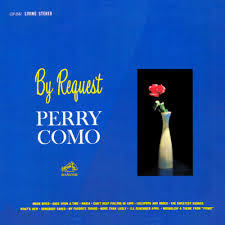
I couldn’t get enough of listening to Como sing Moon River and one that always made me teary: Somebody Cares (click song title links to hear the songs).
There was an album called The Flower Drum Song:

There was another called Cool Water with a drawing of a cowboy fallen from his horse gracing the cover:
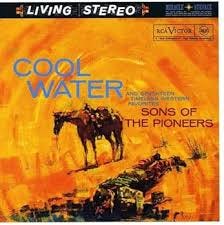
And there was Sing Along with Mitch.
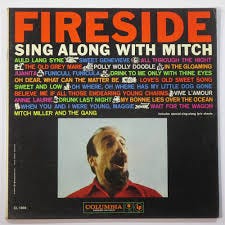
Especially memorable on Mitch’s album was a song that went like this:
My body lies over the ocean.
My body lies over the sea.
My body lies over the ocean.
Oh, bring back my body to me!

Bring back, bring back,
Oh, bring back my body to me, to me.
Bring back, bring back,
Oh, bring back my body to me!
Six decades later, I confess I’m still trying to figure out an awful lot about life, but back then it was especially true—especially vital to me—to try and make sense of the strange world I’d been cast into without having been consulted.
Whenever adults said things that puzzled me, or when lyrics to songs or words in a story confused me, I wrestled with them till I could wedge them squarely into my floundering understanding of the world.
To that end, the way I reasoned out those lyrics so they made sense to me was based on two things. One was the nightly news. The other was religion.
In the early sixties, the nightly news I was exposed to was filled with horrors: the Vietnam War, the brutality of the civil rights movement, the murder and funeral of JFK. That all of it coursed past my young eyes in black and white did little to mitigate its impact. I knew about war and body counts before kindergarten.

Given that, a song about a body didn’t seem all that odd.
The words, body and blood, were also ones I’d heard every week in church since infancy. The priest would say, “When we eat this flesh and drink this blood, we proclaim your death, Lord Jesus, until you come again in glory to judge the living and the dead,” and no one blinked an eye. All the while, in my tiny mind, I pondered why people ate god.
Somewhere between sunset on the Sixth Day of creation and his resting on the Seventh Day, I figured, he must’ve decided to make cannibals and vampires of us all.
In addition to having a body we chowed down on, god also had a spirit. Was a spirit. At least, a third of him was. We called Dieu Le Troisième the Holy Ghost, so I definitely believed in g-g-g-ghosts! just like Scooby Doo.

So, to me, Mitch’s rousting rounds of Bring back, bring back, Oh bring back my body to me, to me! was a war story. Clearly it was a song about a soldier killed in a war whose spirit accompanied his comrades back home but whose body had been buried overseas, and he longed to re-unite body and soul.
Even at the tender age of four, I’d seen plenty of war movies; I also knew my dad had been in a war, and I’d seen the rows and rows of white crosses in France a dozen years before I went there in person as a high school foreign exchange student.
Bring back my body to me fit my pre-schooler’s world view.
I went on singing those lyrics that misguided way until, having learned to read well enough a few years later, I began reading album covers while listening to records.
WHAT?! “My Bonnie Lies Over the Ocean,” the song title read. Who the heck was Bonnie?
And just like that, I had to untether all that imagery, had to re-structure my understanding, after I thought I had it all figured out. It wasn’t easy. In fact, I never really could—or I wouldn’t be sitting here telling you this story now.
Words, especially those illustrated by imagery, stick.
MORE FROM MITCH MILLER
As I sit here typing this, the lyrics of another Sing Along with Mitch song comes back to me. I could look it up, but here’s what I’m remembering of it in the moment:
Drunk last night.
Drunk the night, before.
Gonna get drunk tonight
Like I’ve never been drunk before,
For, when I’m drunk
I’m as happy as can be,
For I am a member
Of the Dutch Company!

Oh, the Dutch Company
Is the best company
That ever came over
From old Germany;
There’s the Rotterdam Dutch
And the Amsterdam Dutch,
The Statendam Dutch,
And the other damn Dutch!
Yeah. I guess my mom didn’t seem to mind me learning to curse and sing about how fun it is to get drunk any more than she minded carving out a future for me as a god-gobbling zealot. But then, Mitch wasn’t the only one teaching me about cussin’ and drinkin’. I had my dad for that.
Not that I ever found fault with him for it. Like I said, I knew he’d gone to war in France. I’d seen the tidy white crosses lined up as far as the eye could see. And I, too, was seeing war every night on TV. I had an early notion of its sobering effects.

To this day, even though I know it’s the wrong word, I still sing body instead of bonnie. It’s partly to be snarky and partly to proclaim the death of every fallen soldier ever left behind.
WRONG AGAIN
My inability to get words right didn’t end when I was four.
In seventh grade, to try out for chorus, we each had to go in one by one and sing The Battle Hymn of the Republic for Mrs. Moore, the music teacher, as she accompanied on piano. I guess she assumed we knew the words, because she didn’t provide any sheet music, but I’d never seen actually the words; I learned the song like I learned a lot of songs—by hearing alone.
So, when she began to play, I sang:
Mine eyes have seen the glory
Of the coming of the Lord;
He is trampling out the vintage
Where the grapes of wrath are stored;
He hath loosed the faithful lightning
Of his terrible, swift sword;
His troops are marching on!
I’d seen a lot of troops on the march on the nightly news, so it made sense to me.
Unfortunately, that didn’t stop Mrs. Moore from scolding me for my ignorance. She might have at least informed me gently of my error, but that wasn’t her way. I did get into chorus, but I was so devastated by her rebuke that I often only mouthed the words to songs, too afraid I’d get something wrong.
But being wrong can be endearing, too, and perhaps because of Mrs. Moore (and the countless other times people shamed me for pronouncing something wrong or simply using the wrong word) I took a decidedly different approach with my own kids.
My hubby and I embraced their malapropisms, and in many cases still use them till today. They’ve become part of our unique family vernacular.
The way I figured it, there was plenty of time for them to get it “right.” Learning something new shouldn’t have to be accompanied by shame.
Our first son, Travis, was so small when our next was born that pronouncing his younger brother’s name was a challenge. Instead of Sullivan, he called him “Nonnanin,” which we shortened, so that even though Sully is a man in his thirties now, he’s often still Nonny to us.

Trav pronounced his own name as “Radish,” and that stuck, too, but was often abbreviated so that we simply called him “Rad” or “The Radman.” He loved a cartoon called James Bond, Junior, but it was “Bonz Dooner” to him, so to this day, whenever the name of James Bond come up in conversation or on TV, my hubby and I shout out, “Bonz Dooner! Bonz Dooner!” When a helicopter flies overhead? We point at it and declare, “doppu-doppu!”
Also, because of our daughter, we never have storms around here. We have storns. And the list goes on.
STICKING POWER
Family vernaculars like ours demonstrate the sticking power of words. But words change across time. There’s even a word for how words change and evolve. It’s etiology.
But words don’t always stick because they’re endearing. Words flung as pejoratives, for example, are made almost entirely of glue. And sometimes that pejorative is someone’s own name, thus, the birth of the term, deadnaming.
Deadnaming someone can be an unintentional slight, but more often it’s a deliberate brand of ignorance: ignoring who they’ve become. You see, people aren’t frozen in time any more than words are. I guess you could say there’s a sort of etiology of personhood.
Recognizing and acknowledging that is an act of love.
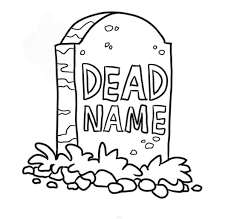
Sure, it can be hard—a little jarring—to have to start calling someone by a name they now go by, when you’ve known them as something else for a long time. It’s especially difficult if their dead name was one you held dear, one that was piled with warm memories and happy moments, at least for you.
This is a problem that transfolk face on a regular basis. Being deadnamed. But it’s not unique to them.
Many other people, for many other reasons, begin going by a new name. Sometimes people go by multiple names simultaneously because the name they go by can vary by circumstance or by the company they’re in. Stage names, pen names, and professional names are a few examples. Some writers even have several pen names, because they write in different genres and want to keep those personas distinct.
I’ve had a couple of socio-culturally astute friends who have, from time to time, turned to me before entering a room or heading out for the day and asked, “how am I introducing you today?” It is always an amazing feeling of being seen and understood, of being respected.
Another kind of name is one I call a Name Of Personal Intimacy. Many of us have had those, too. A NOPI is a name that typically only one other human being calls you. It’s not a nickname. It’s a piece of personal communication and endearment. I have been given several of those, and I have awarded one to a few people in my life, as well.
You needn’t worry about knowing other people’s NOPI’s because you really aren’t meant to. And even if you read or overhear them, you aren’t meant to adopt them, yourself, on a regular basis.
ETIOLOGY, PERSONIOLOGY, SUBSTACKIOLOGY
Words and people evolve. We’ve explored that a bit. But so do Substacks.
If you’ve subscribed to mine, or stopped in now and again, you know it’s been a sort of mish-mash of personal observations tossed amid a series or two or three.
I do hope to muster the wherewithal (great word) to get back to my Around The World in 101 Days series. I believe we left off in Malaysia, back in December of 2024. Yes, that’s right. This is the first substack I’ve written in fourteen months. Like the rest of you, I’ve been struggling with the heavy hand of darkness hanging over the world right now.
War and hatred and prejudice and brutality and murder have always been with us, it’s true, but I want to give a shout out to some whose substacks or other media have been helping me cope, either by keeping me informed or making me laugh. Among them are Heather Cox Richardson, Robert Reich, Amy Goodman of DemocracyNow, Jeff Tiedrich, and Lucian Truscott. Feel free to add your own appreciations or recommendations in comments, below (you can also add stories of malapropism moments of your own).
Back in 2024 I also started a sub-substack called Tea and Tyranny, my own fledgling attempt to address the rising crisis of political decay in America, but quickly saw I wasn’t up to the daily task of tracking and posting about depressing gut-wrenching horrors, especially when so many others were already doing it so well and so faithfully.
I may still occasionally put out an issue of Tea and Tyranny. We’ll see. But I want you to know, despite my not having been posting on substack for the entirity of 2025, I WAS writing elsewhere. Kind of a lot, actually. Perhaps you’ve heard.
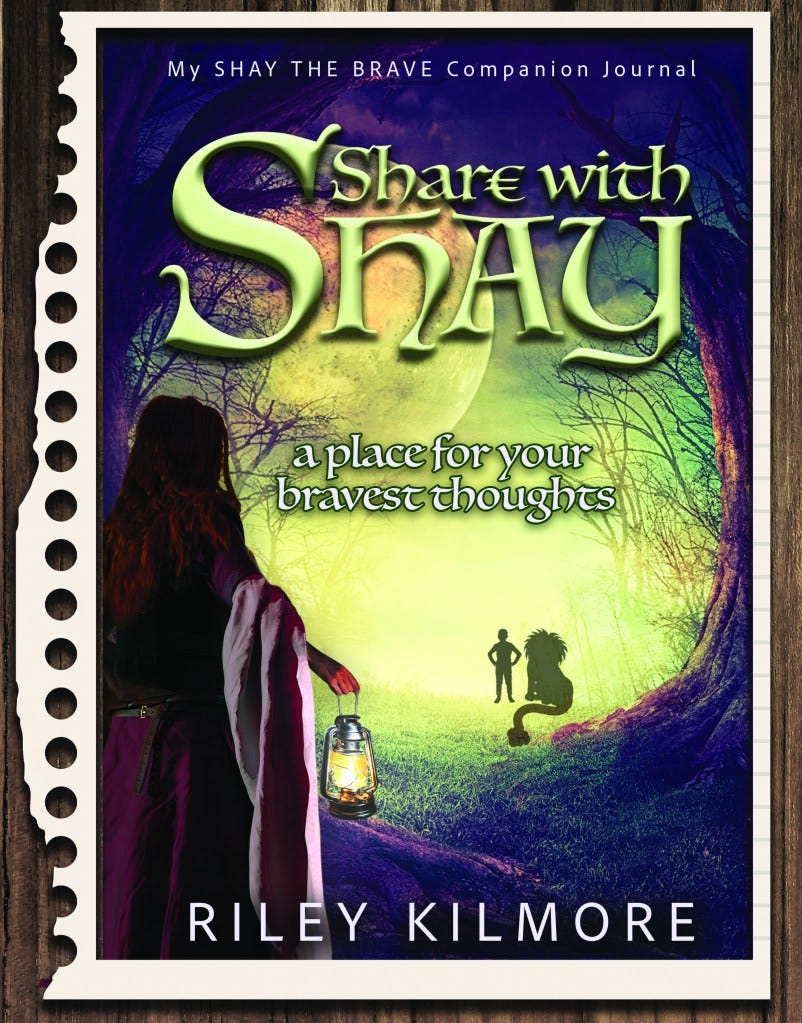
In April of 2025 my second book in the Oldenshire series was published by Wild Ink Publishing: The Share With Shay Workbook.
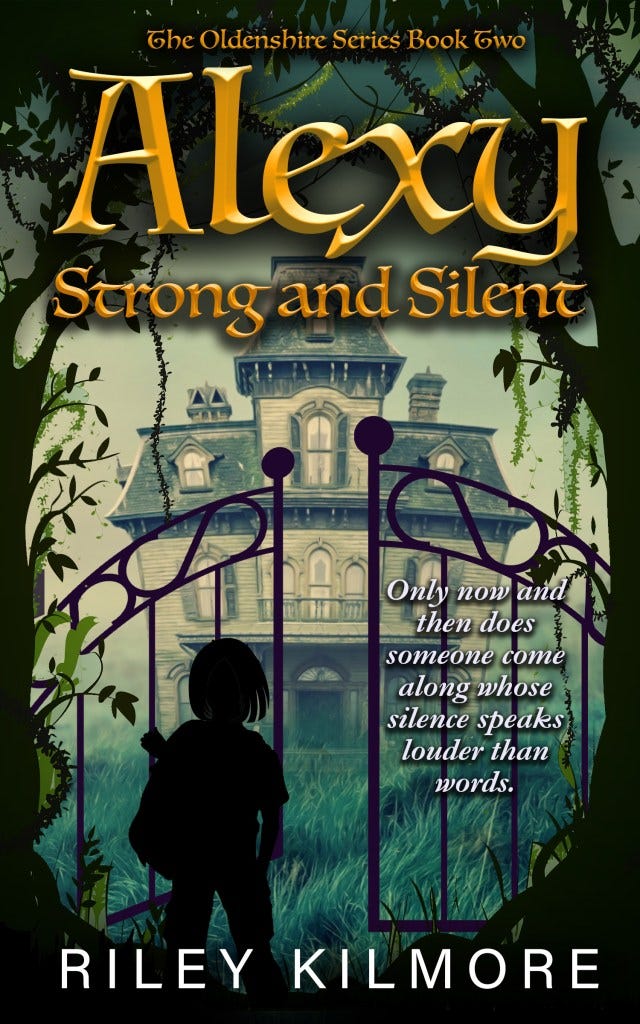
Then, in October, my third book in the series was published, the sequel to Shay The Brave: Alexy, Strong and Silent.
All my books are available online wherever books are sold (please find a source other than Amazon—there are many). They’re also available in some indie bookstores, or most are happy to order copies for you if they aren’t in stock. Support indie bookstores!
You can also reach out to me through my website, www.rileykilmore.com, to purchase copies directly from me.
In addition to having two books come out in 2025, several anthologies included some of my short stories, as well, and rumor has it a first draft for a fourth book in the Oldenshire series has begun.
Finally, I just want to thank all of you for subscribing, reading, commenting, sharing my posts on social media, and restacking. Your support means a lot to me. You can support me through free and paid subscriptions, alike and by inviting others to subscribe, as well. Please peruse my catalogue of old posts and sample some to get acquainted or re-acquainted with me and my work. Thank you!
Happy wording to all, and to all a goodnight!
Wow PJ. That was a lot of work putting those nearly 2500 words your blog and keeping it all interesting with illustrations and topics that seemed to flow nicely from one place to the other. I chuckled about a pre-schooler plus six decades with I've got two more decades on you...but life is always a matter of one's own perspective. My favorite album late in high school and college, was Johnny Mathis and later his first 'hits' album. It always put my dates in a mood for love. They love his singing (and the words) and so I did too. Still do like his pure voice from his early love songs.
Thanks for a walk down memory lane today with your writing. Cheers, M.D.
Welcome back! It’s good to hear your voice again.